Dress one body in layers.
Armour, hair, hats and held items are each their own asset over one bare character, so a game can switch any of them. Colours and skin tones are recoloured for nothing.
Paperdoll guide
Every outfit is a layer.
A layer asset draws its prompt over frames you already have and returns only what it added: a transparent PNG for every frame of every animation, each one lined up with the frame it was painted on. A shirt, trousers, a hat and a sword are four separate layers, so a game can switch each one on its own.
Every frame goes onto one sheet and is repainted in one masked inpaint, which is what keeps an outfit the same across a walk and across eight directions. The skin is keyed cyan first so it can be told from the clothes afterwards, and part of every figure is masked off so the poses cannot move. Each step leaves its file on disk, and a mask you paint yourself replaces the computed one.
- 56 frames dressed by one request: 8 rotations and a walk in 8 directions, for 25 generations.
- The character on this page: a base, four walks, fifteen drawn layers and five held items, 32 frames each, for about 445 generations.
-
regionpicks what may change: the body for clothing, the head for hats, the space around the body for capes and packs. -
attachpins a sprite you already have to the hand in every frame, for nothing, so it is the same item in every frame and always in the same hand. The hand is found from each frame's skeleton.graspadds one small inpaint that closes the fingers around it. - A drawn layer recolours for nothing: one
deriveturns a crimson cape blue in every frame and leaves its fur collar grey. -
offsetnudges a layer by the pixel, for every frame or one loop, and changing it costs nothing: the frames are moved again at download. -
cleanon a loop strips the ghost pixels an animation model leaves, at download, for nothing: 608 stray pixels down to 2 on this walk. - Regenerate the base or a loop and its layers go stale, like everything else drawn from it.
"hero": {"prompt": "bald bare humanoid base body, plain skin" },"hero.walk": {"animation": { "of": "hero", "template": "walking","clean": true, "directions": ["south", "east"] } },"hero.leather": {"prompt": "Dress every masked cyan mannequin in thesame leather ranger armour. Keep the skin cyan.","layer": { "of": ["hero", "hero.walk.south","hero.walk.east"] } },"hero.hat": {"prompt": "The same feathered ranger hat on every head.","layer": { "of": ["hero", "hero.walk.south","hero.walk.east"], "region": "head", "padding": 10 } },"hero.sword": {"layer": { "of": ["hero", "hero.walk.south","hero.walk.east"], "attach": {"item": "items/sword-{direction}.png","anchors": "anchors/hero.json" } } }dark knight
Dress one yourself.
Every button below switches one layer on or off. Each layer is its own asset in the manifest and its own PNG per frame, made without knowing about the others: armour, robes, hair, headwear and what is worn on the back were each drawn by one masked inpaint, and what is held is one sprite pinned to the hand, most with the fingers redrawn around it. The ones marked recoloured cost nothing: they are a drawn layer with its hue turned. So do the skins: the bare base recoloured, with every layer going over it unchanged and the fingers on a held item recoloured to match. The page stacks them and steps them through the same 32 frames, which is all a game has to do. The nudge moves the headwear by whole pixels, the way offset does in a manifest.
8 layers hero + hero.briefs + hero.greaves + hero.plate + hero.warcape + hero.kiteshield + hero.greatsword + hero.helm
The same layers, in 3D.
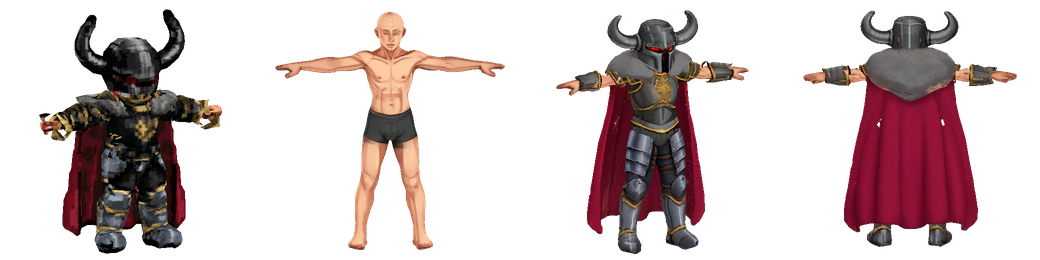
An experiment takes this idea a dimension up: the bare body and each item become separate 3D meshes on one skeleton, with animations a game engine can play. It has its own page, with live models you can turn and dress. Skeletons and rigging shows where rigging fits with the rest.
More of PixelKiln.
- How it worksOne manifest, a price before you spend, and a record of every paid file.
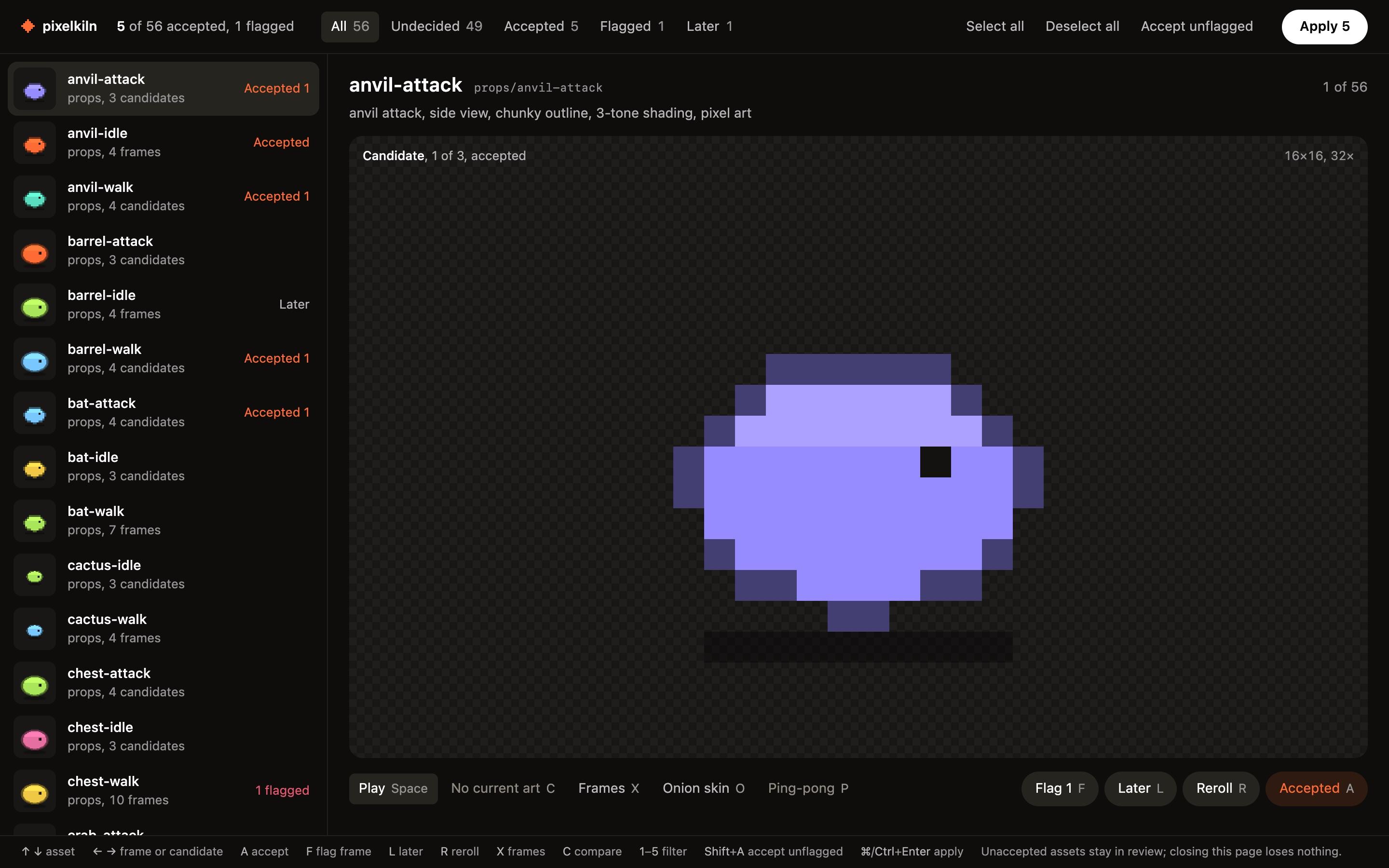
- Review and galleryPick candidates, touch sprites up in the browser, and approve the exact pixels.
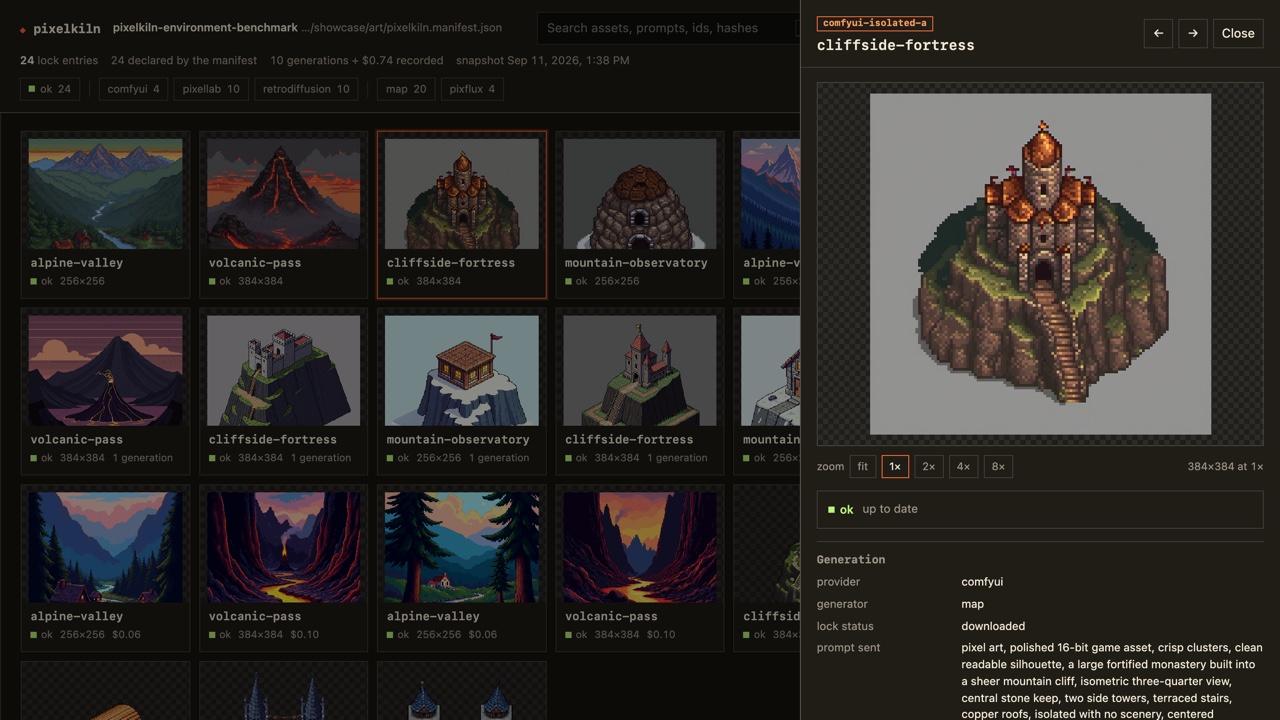
- Characters and loopsA base in eight directions, then every animation drawn from it.
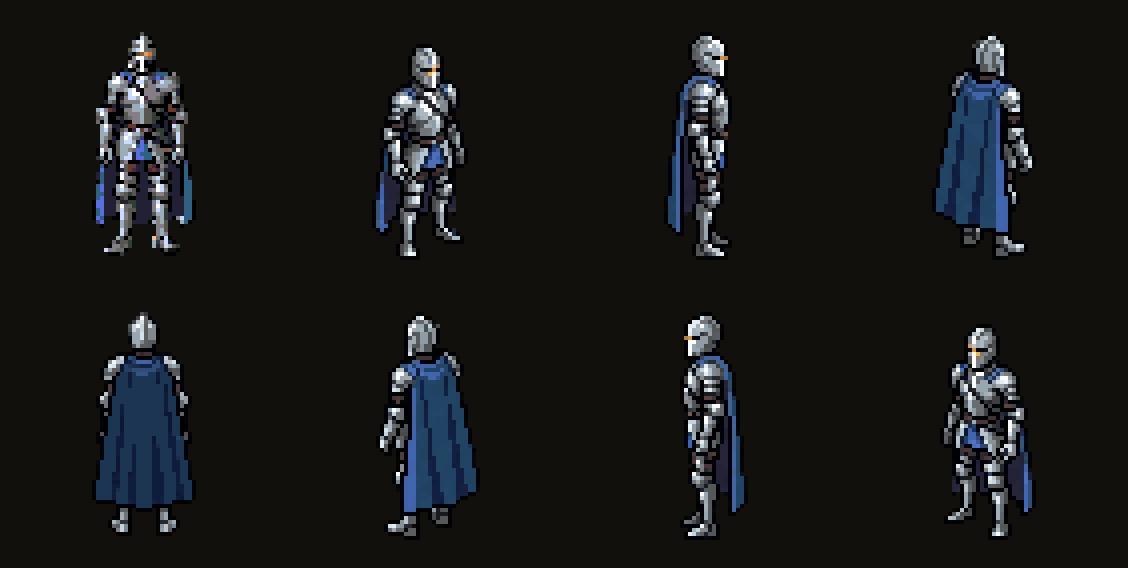
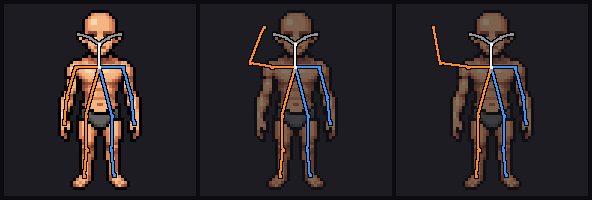
- Skeletons and riggingOne 18-joint skeleton per sprite: estimate it, correct it, animate from it, and pin items to its hands.
- 3D charactersRigged, animated 3D models built from directional sprites, body and items apart.
- EffectsAuras, lightning, shields and hits as frames a game can play, built around your sprite or placed by a pivot, free.

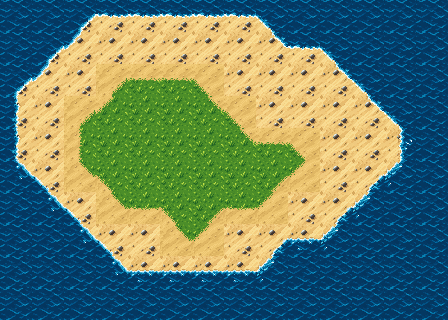
- Tiles and terrainDescribe a border, get every tile that meets it, and export the set to Tiled, Godot or LDtk.
- Providers and costsPixelLab, Retro Diffusion, ComfyUI and Scenario, measured on the same prompts.
Teach your agent PixelKiln.
The skill tells compatible agents when to plan, when to ask for a budget, when to restore existing work, when to stop for human review, and how to verify output.