

Declare
List each asset, its prompt, its provider, and an optional final-art quality profile in one file.
You write the manifest.pixelkiln.manifest.jsonOne committed manifest drives every step. PixelKiln prices the run offline, saves each remote id before polling, and can restore paid work without paying twice.
Quickstart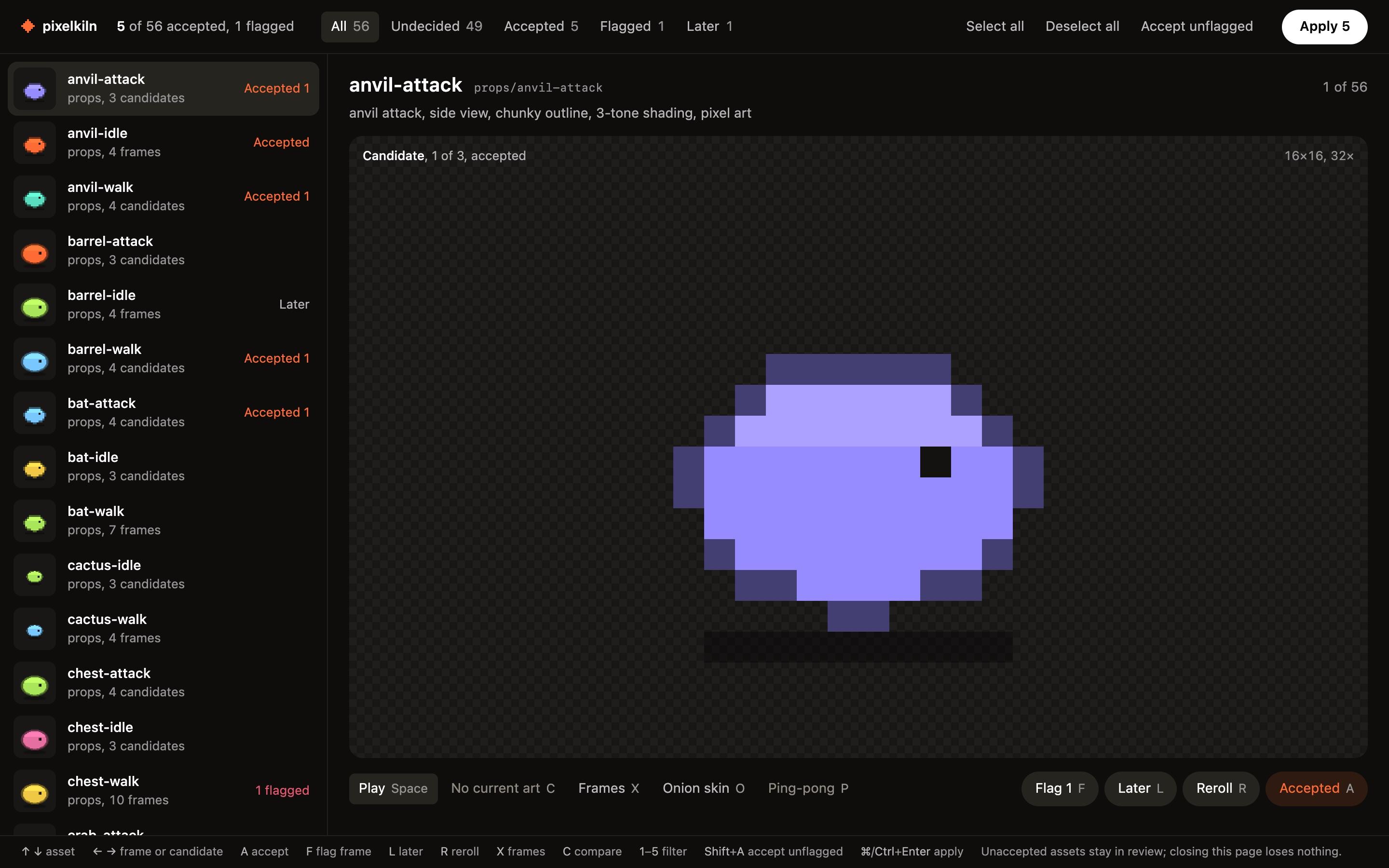
One committed manifest drives every step. Each step says what it reads and what it writes.
List each asset, its prompt, its provider, and an optional final-art quality profile in one file.
You write the manifest.pixelkiln.manifest.json
Compare the manifest with the lockfile and the files on disk. The plan shows what costs money and what you can restore for free, and it makes no provider calls.
Reads the manifest, lockfile, and disk. Spends nothing.pixelkiln plan
Pass a budget and PixelKiln submits, polls, and downloads. It saves each remote id before polling, so a failed download is recoverable work and not a second charge.
Writes the lockfile and the downloaded files.pixelkiln gen --budget 120
Choose from a local candidate sheet, touch a sprite up in the gallery's editor, then approve the exact pixels you ship.
Writes your choice and approval to the lockfile.pixelkiln pick
Build atlases, Aseprite sheet JSON, Godot SpriteFrames, and tilesets for Tiled, Godot and LDtk. A style with a palette rule never ships a color outside it. Quality-profile styles stay blocked until approval is current.
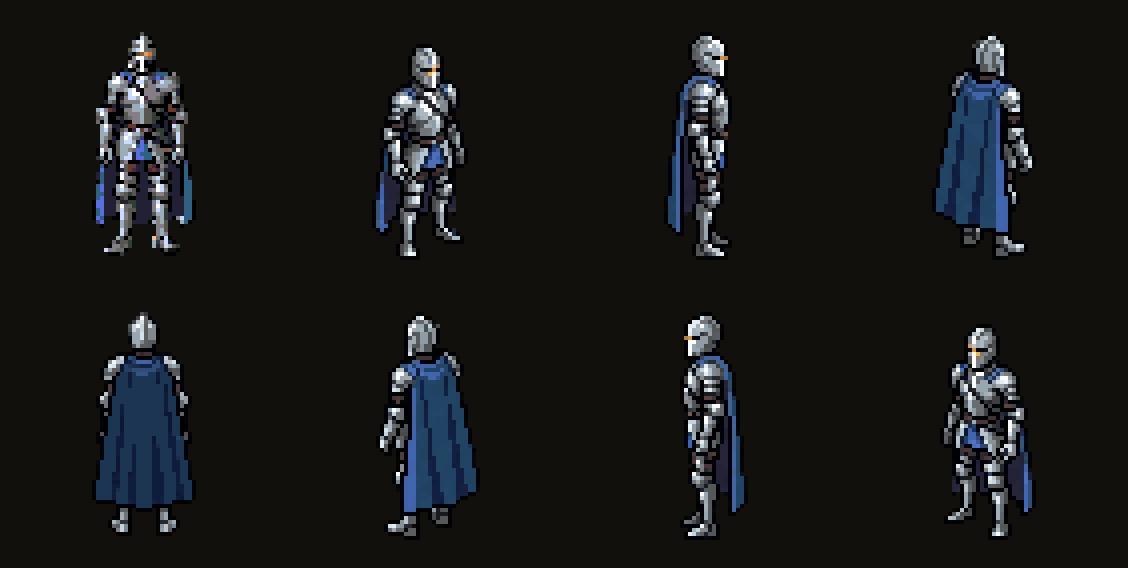
Writes sheets and exports with provenance.pixelkiln packThe same five steps make a single sprite, a character with its loops, or a wardrobe of layers, and one local page to review them in. These are from real runs.
Every provider object, prompt identity, output role, path, and byte hash survives in project state. A failed download remains recoverable work, not a reason to pay twice.
{"base/anvil": {"status": "downloaded","provider": "pixellab","specHash": "61c9…a071","cost": { "value": 1,"unit": "generations" },"outputs": [{"path": "art/base/anvil.png","sha256": "98f1…c42a"}]}}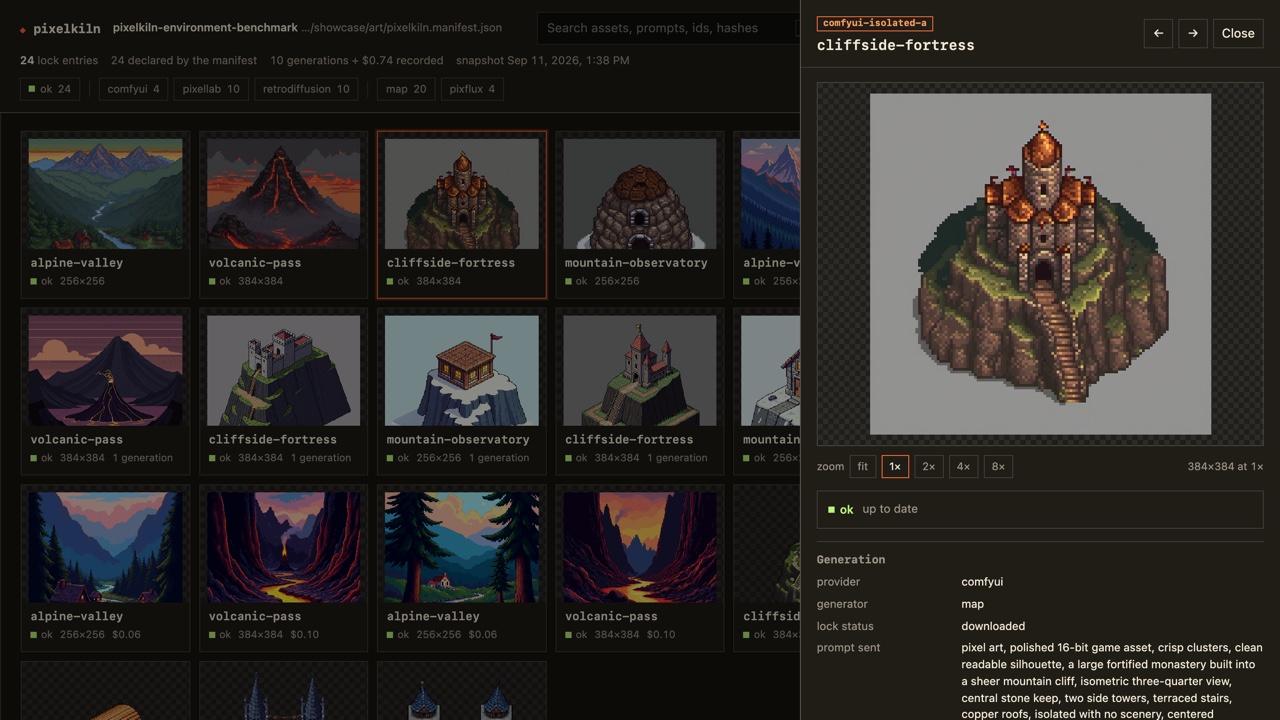











The skill tells compatible agents when to plan, when to ask for a budget, when to restore existing work, when to stop for human review, and how to verify output.
